
Home Seller and Buyer Agree on a Price. What Happens If the Appraisal Comes In Lower?
The buyer and seller agree on a price. Inspections are moving along. Everyone is thinking about closing day.
Then the appraisal arrives—and it is lower than the purchase price.
Does the seller have to lower the price? Does the buyer have to bring more money? Is the deal over?
Not necessarily. For Reno-Sparks buyers and sellers, the next step is to separate three things: what the mortgage company will allow, what the signed contract requires, and what both parties are willing to negotiate.
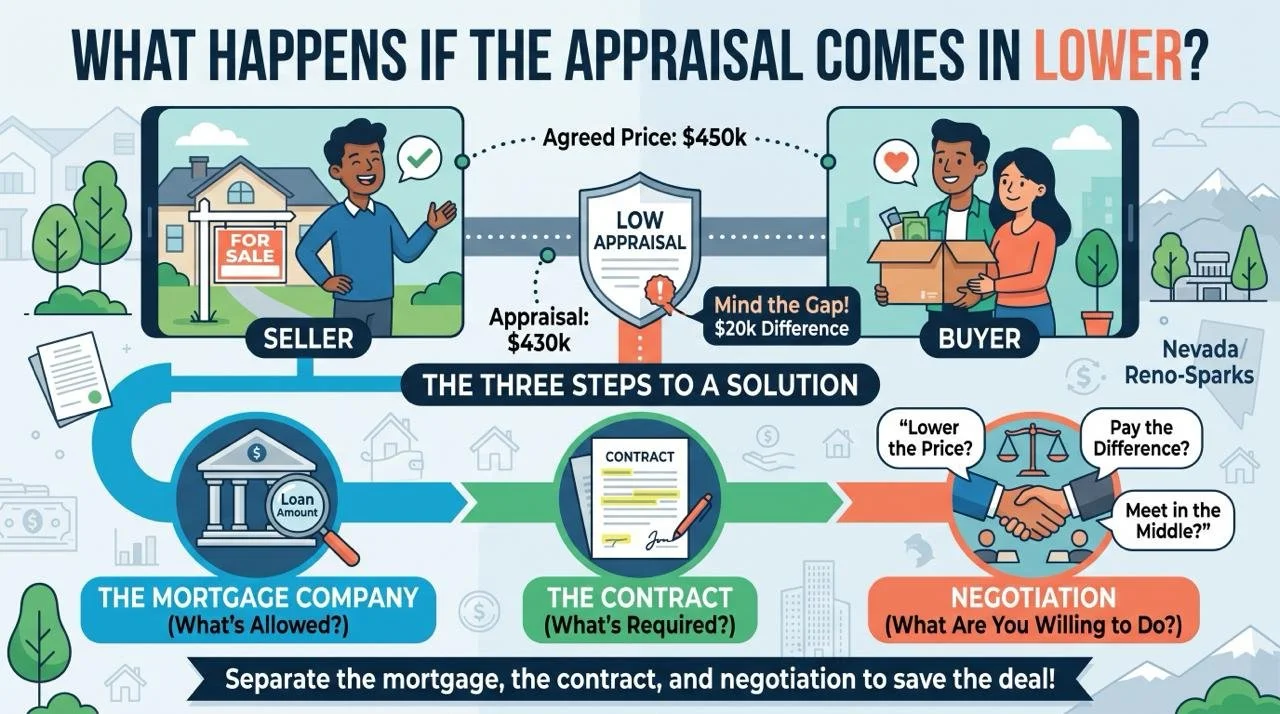
First, Understand What the Appraisal Changes
An appraisal is an opinion of value used in the lending process. It is not an automatic amendment to your purchase agreement. A lower price on the appraisal does not, by itself, force the seller to accept less or require the buyer to pay more cash.
It can change the financing calculation. For a standard Fannie Mae purchase transaction, the loan-to-value ratio uses the lower of the purchase price or current appraised value. Other programs and loan terms can differ, so the buyer’s lender needs to explain the actual impact.
Example: A $550,000 Purchase
Imagine a Reno-Sparks buyer agrees to pay $550,000 and plans to borrow $440,000, down payment of $110,000 toward the price. That is an 80% loan if the appraisal supports the purchase price.
Now suppose the appraisal comes in at $525,000.
If the lender keeps the loan at 80% of that lower value:
The loan becomes $420,000.
At the unchanged $550,000 price, the buyer’s down payment becomes $130,000.
The buyer needs $20,000 more toward the purchase—not automatically the entire $25,000 appraisal gap.
This is an illustration, not a loan quote or a claim about current Reno home values. It excludes closing costs, prepaid expenses, and other adjustments. Any earnest-money deposit already paid would count toward the buyer’s required funds.
Some Solutions To Keep The Deal On Track
There is no single required solution. Depending on the contract, morgage company and terms, and both parties’ priorities, the options may include:
The seller lowers the price. A reduction can narrow or eliminate the gap. The seller is not automatically obligated to agree simply because the appraisal is lower.
The buyer contributes additional funds. That may preserve the agreed price, but the lender must confirm acceptable funds and the buyer should consider what remains for repairs, moving, and reserves.
Both sides compromise. A smaller price reduction combined with additional buyer funds may work. Have the lender recalculate the numbers rather than assuming a “split the difference” agreement solves the financing issue.
The buyer asks about financing alternatives. A revised down payment or loan structure may be possible, but it must still meet qualification requirements. A seller credit is not the same as a price reduction; ask the lender what it can cover and whether it actually helps.
The transaction ends, if the contract allows it. An appraisal or financing contingency may provide a way out, but the exact language, deadlines, notices, and any appraisal-gap commitment matter. Do not assume a low appraisal guarantees cancellation rights or the return of earnest money.
What If the Appraisal Appears Wrong?
Start with specific facts and sales figures, not “we need a higher number.”
Ask the lender about its reconsideration-of-value or second opinion process.
In Reno-Sparks, useful questions might include whether the comparable sales reflect the home’s location, condition, layout, and property type. A house in Spanish Springs should not be treated as interchangeable with every similarly sized house elsewhere in the region simply because both have the same bedroom count.
Your agent can help organize relevant sales and property information for the lender’s process. Do not pressure an appraiser to reach the contract price, and do not order another appraisal assuming the lender must accept it. Confirm the procedure, cost, and timing first.
Protect the Timeline—and Your Budget
Once a low appraisal arrives, review the offer details promptly with your agent and mortgage person.
Before signing a revised agreement, confirm:
The new price, loan amount, and cash needed to close.
Any change to monthly costs or required reserves.
Whether contingency deadlines or the closing date need a written extension.
What happens if the proposed solution does not receive lender approval.
A low appraisal is a problem to evaluate, not an automatic deal-breaker. Assist2Sell Buyers & Sellers Realty can help Reno-Sparks buyers and sellers compare their options, coordinate with the lender, and negotiate with a clearer understanding of the numbers and contract.