
Which Current Design Trends Belong In Your Reno Sparks Home—And Which Should Stay Online?
Warm clay walls. Curved sofas. Vintage pieces. Closed-off rooms. The biggest design ideas of 2026 look inviting on a screen—but a trend earns its place in a Reno-Sparks home only if it also works with bright high-desert light, temperature swings, everyday clutter, and the possibility of a future sale.
The real question is not “Is this trending?” but “Will this make the house function better and still make sense a few years from now?” Here are five ideas through a Northern Nevada lens.
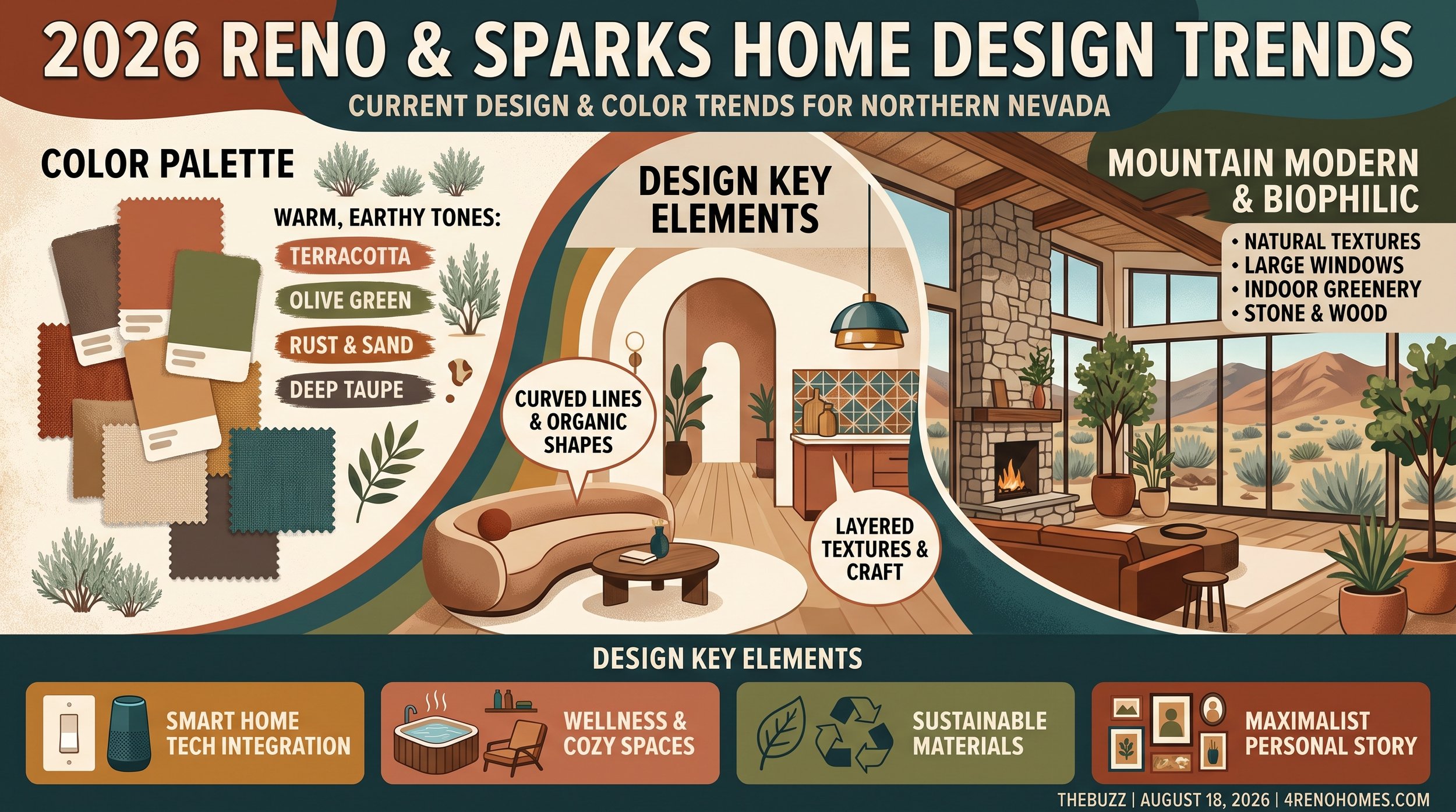
1. Warm color is a yes—but test it
The shift away from stark white and cool gray is real. A recent trend overview highlights clay, sand, mushroom, olive, terracotta, warm taupe, and brown. The American Society of Interior Designers’ 2026 outlook goes further, describing a return to saturated color and visible personality after years of restraint.
Those colors can feel especially at home here because they echo the sage, stone, soil, and mountain tones outside. The catch is our light. Reno-Tahoe International Airport’s 1991–2020 climate normals include about 65 days a year with highs above 90 degrees, so a deep south- or west-facing color can feel more intense—and warmer—than it did on a small sample.
Try this: Paint a movable sample board and look at it in morning, afternoon, and evening light. If resale may be near, put the boldest color in an office, powder room, front door, or removable textile rather than throughout the main living area.
2. Natural texture works better than a “desert theme”
Wood, wool, linen, stone, and handmade objects can add warmth to flat gray-and-white rooms. In Reno-Sparks, the strongest version is subtle: a rug, oak table, woven shade, or unique lamp. You do not need desert or Lake Tahoe art everywhere to feel connected to Northern Nevada.
Matte and woven surfaces can visually soften a bright room, while too many glossy finishes may produce glare. Think about maintenance too: open shelving and heavily textured accessories give high-desert dust more places to settle.
Try this: Add texture in two or three materials. Lean towards movable pieces, and check care instructions and sun exposure before investing in natural fabrics or wood.
3. “Defined rooms” should mean flexible zones, not automatic walls
After years of fully open plans, designers are talking again about dining rooms, libraries, workspaces, and quieter places with a real defined purpose. ASID’s 2026 report says design spending is increasingly focused on flexibility, well-being, and long-term value.
That does’nt mean every open home in Damonte Ranch, Spanish Springs, Somersett, or Sparks needs a remodeling crew. A bookcase, rug, lighting change, or furniture arrangement can create a reading corner or work zone without sacrificing sightlines. In a smaller home or condo, visual separation may be more useful than permanent walls.
Try this: Solve the use first. Noise may require a door; a shapeless room may only need better furniture placement and lighting.
4. Curves are best for character
Rounded tables, arched mirrors, sculptural chairs, and curved sofas continue to appear in 2026 design coverage. Curves can soften a room full of rectangular windows, cabinets, and doors—and may improve movement through a tight seating area if scaled correctly.
The trap is buying a large, unusually shaped sofa because it photographs well. It may limit plans, waste floor area, or become the only thing a buyer notices.
Try this: Introduce the idea with one rounded table, mirror, lamp, or accent chair. Measure the walking path and mark the footprint with painter’s tape before buying a major piece.
5. The smartest kitchen trend is hiding the work
The most interesting 2026 kitchen idea is not a color. It is useful storage. Houzz’s 2026 U.S. Kitchen Trends Study, based on nearly 1,800 respondents, found that 76% of renovating homeowners added specialty built-ins. Pantry cabinets were the most commonly cited example, while drink stations and pull-out waste or recycling storage were also popular.
For kitchens that share sightlines with the living area, a full butler’s pantry is not required. An appliance garage, deep drawers, tray dividers, or a coffee shelf can reduce visible clutter and make routines easier.
Try this: Before adding cabinets, track what actually ends up on the counter for a week. Design around that evidence rather than a showroom wish list.
If you’re thinking of selling, separate “personality” from “permanence”
If a move may be coming, use paint, art, rugs, lighting, and furniture for personal choices; keep expensive fixed finishes more adaptable. That is not a call for blandness. It lets you enjoy a trend without asking a future buyer to love every permanent decision.
The National Association of Realtors’ 2025 staging research found that 83% of buyers’ agents said staging made it easier for buyers to visualize a property as a future home. The practical lesson is clarity: home buyers should be able to understand each room even when the home has character.
The best Reno-Sparks update handles our light, supports daily life, fits the home, and avoids an expensive resale problem later.
Thinking about updating before a sale? Assist2Sell Buyers & Sellers Realty can help you compare which changes may improve presentation and which may not be worth the cost for your particular Reno-Sparks home.